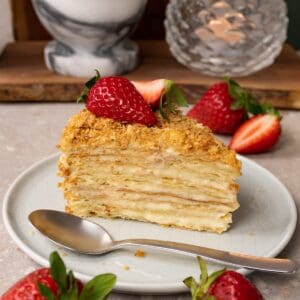
Napoleon Cake
If you've never made a Napoleon cake before, this recipe is going to become one of your most impressive bakes. Thin, flaky pastry layers are stacked with a light, silky pastry cream and left to rest overnight until the layers soften into something almost impossibly delicate. It takes a little patience, but every single step is straightforward and the result is absolutely stunning.
Print
Pin
Servings: 10 pieces
Calories: 475kcal
Equipment
- Digital kitchen scale
- Hand mixer
- Rubber spatula
- Rolling Pin
- Saucepan
- Parchment paper
- Whisk
Ingredients
For the cake layers
- 300 g all-purpose flour plus more for dusting
- 1 teaspoon salt
- 1 tablespoon white sugar
- 200 g unsalted butter very cold or slightly frozen
- 1 large egg cold
- 120 g ice-cold water
- 1 tablespoon apple cider vinegar
For the cream
- 150 g granulated sugar
- 25 g cornstarch
- ½ teaspoon salt
- 6 egg yolks can be cold
- 1 teaspoon vanilla extract
- 400 g whole milk can be cold
- 15 g unsalted butter can be cold
- 200 g heavy whipping cream cold
- 2 tablespoon powdered sugar
Instructions
For the pastry (read the post to learn how to make this cake with store-bought puff pastry)
- In a bowl, combine the flour, sugar, and salt.
- Grate the butter directly into the bowl using the large holes of a box grater. Work the flour into the butter using a pastry cutter or by hand until the mixture resembles a coarse meal.
- In another bowl, combine the cold egg, ice-cold water, and vinegar. Whisk with a fork to break up the egg.
- Pour into the center of the dry ingredients in several additions, mixing with a fork between each one. Finish bringing the dough together with your hands but don't knead it, just press until a dough ball forms. Shape it into a log, split into 9 even pieces, and roll into balls. Place on a large plate, cover with plastic wrap, and freeze until very cold but still pliable. You can also refrigerate the dough overnight.
- Meanwhile, preheat the oven to 200C (400F) and prepare 4 pieces of parchment paper and a baking sheet.
- When the dough has chilled, take one ball at a time out of the freezer. Dust the rolling surface, the pin, and the dough ball with flour. I recommend rolling the dough directly on parchment paper. Roll it out thinly into a roughly 9½–10 inch (24–25 cm) circle and bake as is. You will cut out the 7-inch disk after baking.
- Prick the dough all over with a fork and bake for 10-12 minutes or until golden. If your oven has hot spots, rotate the baking sheet once one side turns golden brown.
- Remove from the oven and place the parchment paper with the baked pastry on a flat surface. Let it rest for 1 minute, then cut out a 7-inch (18cm) round cake layer using a metal cake ring and a small knife, or use a 7-inch paper stencil prepared in advance. Place the trimmings on a separate plate. Repeat with the rest of the dough.
For the pastry cream
- In a saucepan, combine the sugar, cornstarch, and salt.
- Add the egg yolks and vanilla extract and mix well.
- Pour in the milk. Cook over medium heat, whisking constantly, until the mixture thickens to a pudding-like consistency, about 5 minutes. Lower the heat and cook for a further 1-2 minutes, still whisking. Remove from the heat and add the butter, mixing until fully incorporated.
- Pour into a clean bowl, cover with plastic wrap pressed directly onto the surface, and place in the freezer for 30 minutes to 1 hour until cold. Alternatively, leave it in the saucepan, cover the same way, and refrigerate overnight.
- Once the cake layers are at room temperature and the pastry cream is cold, whip the heavy cream with the powdered sugar to medium peaks.
- Whip the cold pastry cream until smooth and glossy, then fold in the whipped cream with a rubber spatula until fully combined.
Assembling the cake
- Spread a small amount of cream onto the serving plate to anchor the cake. Place the first cake layer on top and press gently.
- Add around 85g (approximately ⅓ cup but I recommend using kitchen scale to make sure you will have enough cream to crumb coat the cake) of cream on top and spread evenly with an offset spatula. Place the next cake layer on top and press gently. Continue until all cake layers are used.
- Use the remaining cream to make a crumb coat and fill any gaps on the sides.
- Place the pastry trimmings in a food processor and pulse until sandy. Cover the top and sides of the cake with the crumbs, then place in an airtight cake box or cover with plastic wrap and refrigerate for a minimum of 6 hours, or preferably overnight, to allow the cake layers to soften. Decorate as desired and serve.
Video
Notes
Store it in a plastic cake container in the fridge for 4-5 days. You can also wrap it in plastic wrap if you don’t have a cake container.
Freeze the dough for up to 2 months. Wrap it in plastic wrap and then in a piece of foil before freezing. Thaw in the fridge overnight before rolling out.
Nutrition
Nutrition Facts
Napoleon Cake
Serving Size
1 piece
Amount per Serving
Calories
475
% Daily Value*
Fat
30
g
46
%
Saturated Fat
18
g
113
%
Trans Fat
1
g
Polyunsaturated Fat
2
g
Monounsaturated Fat
8
g
Cholesterol
207
mg
69
%
Sodium
424
mg
18
%
Potassium
138
mg
4
%
Carbohydrates
45
g
15
%
Fiber
1
g
4
%
Sugar
19
g
21
%
Protein
7
g
14
%
Vitamin A
1079
IU
22
%
Vitamin C
0.1
mg
0
%
Calcium
91
mg
9
%
Iron
2
mg
11
%
* Percent Daily Values are based on a 2000 calorie diet.
Tried this recipe?Mention @sugarpursuit or tag #sugarpursuit!